Live Webinar






- Which university ranking should I trust?
- The 4 Top international rankings
- The 3 Top national rankings
- Germany in International Rankings: A Top 3 Global Higher Education Hub
- About the National rankings
- Does the ranking of a university matter in Germany?
 Germany's largest study program database
 Browse study programs
24,216 courses available
 What to study?
  Where to study?
 What to study?
Where to study?
If you are going to invest a lot of time and effort in your education, you want to make sure you are doing it in the best place. International students understandably turn to rankings to help them find the best German university. But before you do, you need to decide which rankings best reflect what you are looking for in a good university. This article will help you navigate the landscape of university rankings and introduce you to different factors to consider when including rankings in your decision-making process about where to study in Germany.
Can You Trust University Rankings? Which One is Reliable?
There are various international and national university rankings, each using its own criteria—mostly focused on research performance—to define what makes a university “good.” However, these rankings often have different interpretations of what qualifies as a university. In Germany, this means that reputable Universities of Applied Sciences (Fachhochschulen) are frequently excluded. Another limitation is that some rankings primarily measure research output through journal publications, disadvantaging universities strong in humanities, where books play a bigger role than journal articles. Ultimately, no single ranking provides the full picture of Germany’s higher education system. Instead of relying on just one, it’s best to consider multiple rankings and evaluate them based on your academic and career goals.


The 4 Major International University Rankings: Shanghai, THE, QS, and Webometrics

University rankings can be a useful tool to compare specific aspects of different institutions. While there are several international rankings, such as U-Multirank, the following four are the most influential in terms of public perception:
• Shanghai Ranking (ARWU) – Focuses on research excellence
• Times Higher Education (THE) – Balances teaching, research, and citations
• QS World University Rankings – Includes employer reputation and international outlook
• Webometrics – Measures universities’ online presence and impact
Explore our comparison tables to see which ranking aligns best with what matters most to you.
Table: Comparison of Worldwide University Rankings
| Academic Ranking of World Universities (Shanghai Ranking; AWRU) | Times Higher Education (THE) World University Ranking | QS World University Ranking | Ranking Web (Webometrics Ranking of World Universities) | ||
| Issued by | Shanghai Ranking Consultancy (before 2009: Center for World-Class Universities Graduate School of Education, Shanghai Jiao Tong University). |
London-based newspaper Times Higher Education in cooperation with Elsevier. | London-based Quacquarelli Symonds (QS). | Cybermetrics Lab @ Consejo Superior de Investigaciones Científicas. | Issued by |
| Frequency of publication | Annually (since 2003). | Annually (since 2004; new methodology since 2010). | Annually. | Semi-annually (since 2004). | Frequency of publication |
| Level of comparison | Institutional; (field & subject rankings available). | Institutional; (subject & teaching-focused rankings available). | Institutional; (subject & other rankings available). | Institutional. | Level of comparison |
| # of institutions | 1,000 published (1,800 ranked). | Approx. 1,400. | 1,002. | 31,000. | # of institutions |
| # German Unis | 51 (2019 edition). |
48 (2020 edition). |
45 (2021 edition). |
464 (July 2020 edition). |
# German Unis |
| Focus on | Research performance. | Teaching, research, and knowledge transfer. | University reputation and academic performance. | Web performance. | Focus on |
| Ranking parameters |
Quality of education.
Quality of faculty.
Research output.
Per capita performance of university. |
Teaching.
Research.
Citations. International outlook.
Industry income. |
Academic reputation.
Employer reputation.
Faculty/Student ratio. Citations per faculty. International faculty & international student ratios. |
Presence.
Visibility.
Transparency/Openness.
Excellence/Scholar.
|
Ranking parameters |
| Strengths | Highly regarded globally. | Includes survey-based indicators. | Approved by the International Ranking Expert Group (IREG). | Includes a large number of ranked universities. | Strengths |
| Website | www.shanghairanking.com | www.timeshighereducation.com | www.topuniversities.com | www.webometrics.info | Website |
The 3 Major National University Rankings in Germany: Humboldt, CHE, and DFG
Table: Comparison of German University Rankings
| Humboldt-Ranking | CHE-Ranking | DFG Ranking (‘Förderatlas’) | |
| Issued by | Alexander von Humboldt Foundation | Centrum für Hochschulentwicklung; cooperation partner German newspaper Die Zeit | Deutsche Forschungsgemeinschaft (DFG, German Research Foundation) |
| Frequency of publication | 2009; 2012; 2014; 2017 | Updated annually (since 1998) | Tri-annually (since 1997) |
| Level of comparison | Institutional; departmental | Subject-performance across universities |
Institutional; departmental information available |
| # of institutions | 79 | 37 subject-fields at 296 universities | 85 universities with DFG support |
| Focus on | Reputation & popularity among international researchers | Many indicators that may influence a students’ decision of where to study | Research performance |
| Ranking parameters | # of holders of Humboldt foundation scholarship @ the institution |
Facts about a subject at the universities, e.g. # of international students, specialties about the library. Analyses, e.g. research reputation. Student opinions, based on comprehensive surveys |
Amounts of research funding universities could allocate from DFG |
| Strengths | Also lists non-university research institutions |
Specifically targeted at students, possibility to choose your own selection criteria |
|
| Website | www.humboldt-foundation.de | https://ranking.zeit.de/che/en/ | https://sites.dfg.de/sites/foerderatlas2021/ |
Germany in International Rankings: A Top 3 Global Higher Education Hub

The German higher education system fares well in international rankings. If you take the Top 200 as the basis, Germany is the 3rd nation (right after the USA and the UK) in the
- THE ranking,
- QS ranking
- Shanghai ranking (to be consistent with THE and QS, only China mainland is considered).
- and Webometrics Ranking of World Universities.
This means that Germany is rated as one of the globally most excellent spots to study.
Shanghai ranking (2019 update)

German universities are amongst the front runners in the Shanghai ranking. 51 German universities made the 2019 ranking, with Heidelberg University, LMU Munich, Technical University of Munich and the University of Bonn making it into the top 100. This is a good turnout for German universities in the Shanghai Ranking, which ranks 1,800 universities from all over the world, but only publishes a list of the best 1,000. A good reason to let this influence your decision is that many employers around the world may respect you have studied at a university that is top-ranked by this widely renowned ranking.
THE ranking

German universities are the closest contenders to the US-American and UK universities in the THE ranking. In the 2020 ranking, Germany has 23 universities placed in the top 200 and the LMU Munich, Technical University of Munich, Heidelberg University, Humboldt University of Berlin, Charité Berlin, University of Freiburg, University of Tübingen and RWTH Aachen made the top-100, as well. The sample for the 2020 ranking consists of almost 1,400 institutions, the lowest group score assigned to universities is ‘1,001+’.
Like the Shanghai-ranking, this list also focuses on research performance but also includes other criteria, such as an institution’s performance in teaching, knowledge transfer, and international outlook. The latter point may be of special interest to international students, as well as the fact that the THE includes results based on student surveys. This information may influence your decision on where to study. However, keep in mind that universities of applied sciences are not included in this list.
QS ranking

In the 2021 ranking sample of 1,003 institutions, the QS ranking placed 45 German universities. Three German institutions secured a place among the top 100 universities: Technical University of Munich, LUM Munich, and Heidelberg University. The ranking organization behind this ranking, London-based QS Quacquarelli Symonds, used to cooperate with the Times Higher Education newspaper on the THE ranking until their cooperation broke apart in 2009.
Both rankings are similar in including survey-based results. Since the QS-ranking includes employer surveys, it captures the reputation of an institution and is therefore especially interesting for students trying to ensure good employability. The parameters measured by the ranking are an institution’s academic and employer reputation, faculty/student ratio, citations per faculty as well as the ratios of international faculty and students.
About the National rankings

In addition to international rankings, Germany has several national rankings that provide valuable insights into university performance. These rankings focus on factors like research funding, teaching quality, and academic reputation within Germany.
Humboldt ranking

© Wolkenkratzer. Type of license: CC BY-SA 3.0.
The ranking organization behind the Humboldt ranking is the Alexander von Humboldt Foundation which promotes academic cooperation between excellent scientists and scholars from abroad and from Germany through their prestigious fellowship program (the Humboldt Research Fellowship). Their ranking shows which German universities international fellowship-holders chose for a research stay in Germany. Thus, it lists German institutions only and is an indicator of high international reputation, popularity, and well-established international networks. The latest ranking was published in 2017.
This ranking can be especially interesting for students who plan to pursue an academic career. The Humboldt ranking lists not only university performances, but also which departments international researchers chose. This can help you find out if your university is not just overall strong but also in the specific department you are looking to join. Furthermore, a separate ranking of non-university research institutions can give you insights into the top institutions of the German research landscape.
CHE ranking
The CHE ranking is created by the German non-profit organization Centrum für Hochschulentwicklung and published in cooperation with the German newspaper Die Zeit. The intended audience for this ranking are prospective students, the goal is to aid them to decide on where in Germany to study. Therefore, it covers parameters that may be important to prospective students: facts and numbers about student towns, universities, and subjects are compiled in cooperation with the universities. Also, bibliometric analyses are included to include parameters measuring e.g. the research performance, and lastly, student surveys are included to capture students’ perspectives on studying their subject at their university.
After registering for free on the website, you can look for a specific subject and compare all German universities that offer this subject by criteria that you can select as most important for you. This can be a broad array of things, such as how many students use their bikes in that town, the number of seats available in the library, the number of students graduating in time, or the research output. We recommend you have a look at this ranking because it can give you a good idea of what it’s like to be a student of a certain subject in a certain city.
DFG ranking
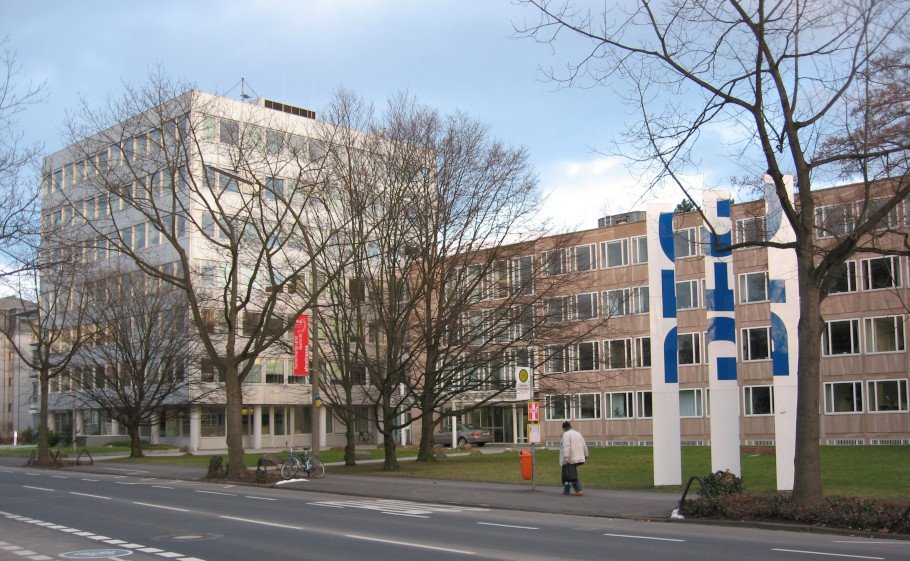
© Mkill. Type of license: CC BY-SA 3.0.
The DFG Ranking is a national ranking capturing research performance. It indicates which universities in Germany were most successful in allocating third-party funding from the Deutsche Forschungsgemeinschaft (DFG, German Research Foundation). With an annual budget of 3,4 Billion € (2018), the DFG is Germany’s central research funding organization. The ranking is considered an indicator of the quality of research at a higher education institution. It gets published tri-annually by the DFG, most recently in 2018. You can access an overview of the 40 universities with the highest third-party funding here.
Third party-funding can be a good indicator for you to understand which universities are understood to conduct especially meaningful research, and a department with well-funded projects may also provide a good study environment for you. You should keep in mind, however, that this ranking does not provide insights into the quality of teaching.
Does the ranking of a university matter in Germany?

University rankings in Germany do matter - but only a little bit. German universities do want to be able to compete internationally and landing on the international rankings is one way to boost international recognition. You can also observe recent initiatives, such as the Excellence Initiative started in 2005, as an attempt to push some German universities and research clusters into the international top-levels. After all, who wouldn’t want to be ranked as one of the best?
However, the overall mindset is that rankings are not really important. The German university system is fairly egalitarian, meaning that expertise is spread throughout the higher education landscape. Different universities are renowned for different things. The attitude among many students here is that you do not necessarily need to find the best university according to some ranking, but the best university FOR YOU.
That is also the advice we want to leave you with: think of what you need from a university and what your goals are. University rankings may give you an initial orientation of which school might be a good fit for you. Depending on what your priorities are, a ranking may even sway your decision. Or maybe you won’t look at rankings at all, which is also perfectly fine.

Advice Box
It’s important to remember that no ranking tells the full story of what makes a great university education. Even if a university ranks highly, its strength may not align with your specific subject area. For a practice-oriented education, consider Universities of Applied Sciences (Fachhochschulen), which often have strong industry connections and career-focused programs. Most importantly, look beyond rankings and focus on the actual study programs offered. Explore course content, specializations, and teaching methods to find the best fit for your goals.
🔍 Use the StudyFinder to discover your ideal study program in Germany!